
 Japanese
RESEARCH NEWS Researchers at Nagoya Institute of Technology Reveal New Mixing Guidelines for Dense Suspensions
Category:News|Publishing : May 25, 2026
Solid-liquid mixing is a crucial step for many industrial processes ranging from battery electrode manufacturing to pharmaceutical formulations. These processes often require uniform suspension of particles to ensure consistent product quality. For decades, engineers have always relied on Zwietering's correlation, a classic engineering model effective in estimating the just-suspended speed (N JS), which is the minimum impeller rotation speed that prevents particles from settling down.
"Zwietering's correlation predicts that N JS increases with larger particles, greater density differences, and smaller impellers. Although this works well for dilute suspensions, it often fails to predict behavior in dense industrial slurries," explains Dr. FURUKAWA Haruki, Assistant Professor at the Department of Life Science and Applied Chemistry, Nagoya Institute of Technology (NITech), Japan.
To develop more reliable mixing guidelines for high-density suspensions, a research team led by Dr. FURUKAWA along with Dr. KATO Yoshihito from the Department of Life Science and Applied Chemistry, NITech, explored how impeller placement affects mixing behavior and energy efficiency in suspensions containing 20-70 wt% solid particles. The findings of the study were made available online on March 25, 2026, and will be published in Volume 187 of the Journal of the Taiwan Institute of Chemical Engineers on October 1, 2026.
The researchers examined the mixing performance of suspensions in a stirred vessel by changing impeller positions under both baffled and unbaffled conditions. They evaluated the particle behavior by measuring torque and power, along with visual determination of N JS. Their experiments revealed that in baffled conditions, placing the impeller near the solid-liquid interface (the boundary between the settled particle bed and the liquid above) resulted in a reduction of N JS as compared with lower impeller positions. Meanwhile, unbaffled conditions reduced the N JS overall, suggesting a more energy-efficient approach for mixing dense slurries.
These findings were in contrast to the Zwietering's experiments, which are usually conducted with baffled vessels, with the widely held assumption suggesting that placing the impeller lower in the vessel enhances particle lifting and reduces N JS. They also show that variation in power consumption did not always result in the onset of full suspension in dense slurries. Based on these observations, the researchers concluded that commonly used principles in Zwietering's correlation may not be reliable at high particle concentrations.
"We also observed that the classical Zwietering correlation underestimates suspension requirements at high solids, with a sharp rise in concentration exponent," notes Dr. FURUKAWA. "This redefines the rules for mixing design in dense suspensions."
Overall, the study holds significant value for industries handling dense suspensions, offering new mixing design principles to improve energy efficiency, process reliability, and product uniformity.
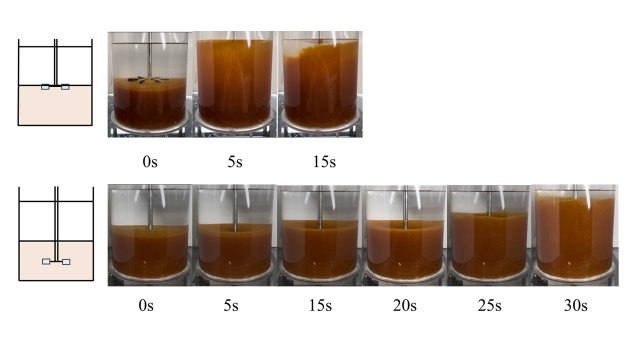
Caption: Particle suspension behavior in a 50 wt% solid-liquid suspension at 140 rpm for two impeller positions. Placement near the solid-liquid interface achieved suspension within 15 seconds, whereas lower placement required up to 30 seconds for complete particle suspension.
Reference
|
Title of original paper |
Effect of impeller placement on solid-liquid mixing at high particle loadings |
|
Journal |
Journal of the Taiwan Institute of Chemical Engineers |
|
DOI |
10.1016/j.jtice.2026.106738 |
|
Latest Article Publication Date |
October 1, 2026 |
About Assistant Professor FURUKAWA Haruki from Nagoya Institute of Technology, Japan
Dr. FURUKAWA Haruki is an Assistant Professor in the Department of Life Science and Applied Chemistry at the Nagoya Institute of Technology (NITech), Japan. He received his Doctor of Engineering degree from Yokohama National University in 2016, after completing his Master's (2013) and Bachelor's (2011) degrees at NITech. To date, he has published more than 80 research publications, with research spanning computational fluid dynamics, fluid mixing, impeller design, and flow behavior in viscous and viscoelastic fluids. His work has been recognized with several honors, including the 2024 Best Reviewer Award from the Society of Chemical Engineers, Japan.
Contact
Assistant Professor FURUKAWA Haruki
https://pure.nitech.ac.jp/en/persons/haruki-furukawa/
E-mail : furukawa.haruki [at] nitech.ac.jp
*Please replace [at] with @ when contacting.
RESEARCH NEWS Scientists at Nagoya Institute of Technology Uncover Molecular Basis of Red-Green Color Vision [Initiative Introduction] - Distinguished Professor KANDORI Hideki gives a lecture at the 251st Life Science Forum