
 Japanese
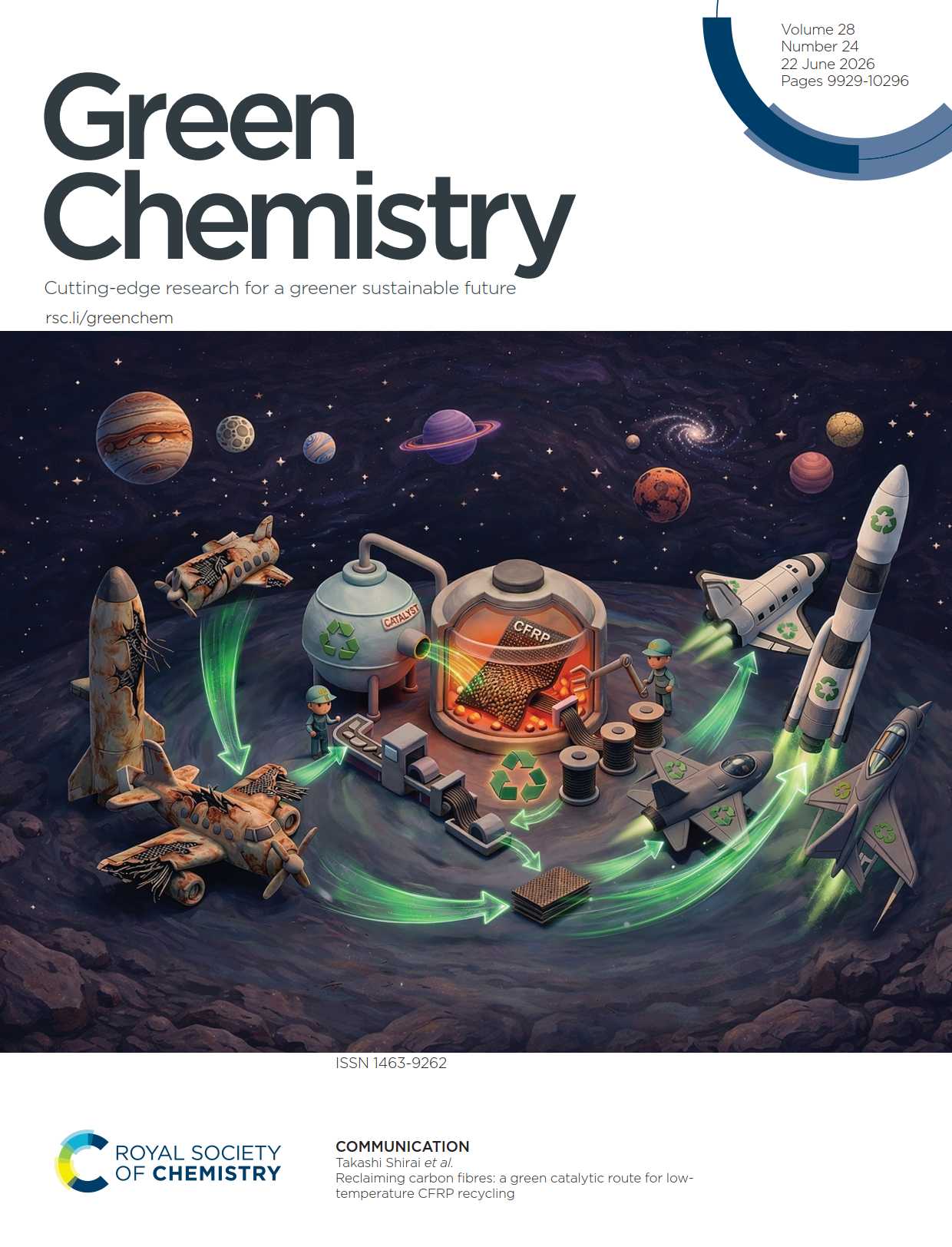
Research results from the SHIRAI Laboratory selected for the "Outside Front Cover" of Green Chemistry
Category:News|Publishing : September 1, 2026
A research paper by the SHIRAI Laboratory on a novel low-temperature recycling technology for carbon fiber reinforced plastics (CFRP) using a solid catalyst, titled "Reclaiming carbon fibers: a green catalytic route for low-temperature CFRP recycling," has been highly praised and selected for the Outside Front Cover of the journal "Green Chemistry," published by the Royal Society of Chemistry.
Because CFRP is lightweight yet possesses high strength, rigidity, and corrosion resistance, its use is expanding in a wide range of fields, including aircraft, automobiles, wind power generation equipment, and sporting goods. In recent years, with the aim of realizing a decarbonized society, there has been a growing demand for energy conservation through the lightweighting of transportation equipment, and the demand for CFRP is expected to increase even further in the future.
On the other hand, because CFRP is a composite material composed of carbon fibers and thermosetting resin, it faces the challenge of being difficult to recycle after use. Currently, much of the used CFRP is disposed of in landfills, and there is a strong need for the development of new recycling technologies from the perspective of resource circulation and reducing environmental impact. While various recycling technologies such as mechanical pulverization, solvent decomposition, and thermal decomposition have been considered, they have presented many challenges, including damage to carbon fibers, the need for high-temperature and high-pressure conditions, and the use of large amounts of organic solvents.
This study successfully demonstrated the selective decomposition of epoxy resin using a solid catalyst technology based on activated hydroxyapatite and polycrystalline platinum nanoparticles developed by the research team, enabling the recovery of high-quality carbon fibers without damage. Furthermore, since this method does not require organic solvents and can be applied to long carbon fibers, it is expected to be a next-generation recycling technology that achieves both reduced environmental impact and resource circulation. This achievement is expected to serve as a fundamental technology contributing to the realization of a circular economy and a decarbonized society, and further development and social implementation are anticipated in the future.
Paper information
<Publication Journal> Green Chemistry, Vol.28, No.24, 9929-10296 (2026)
<Published paper> Reclaiming carbon fibers: a green catalytic route for low-temperature CFRP recycling
<Contents> Outside Front Cover
<URL>https://pubs.rsc.org/en/content/articlelanding/2026/gc/d5gc06006k