
 Japanese
RESEARCH NEWS Nagoya Institute of Technology Researchers Offer New Insights for Industrial Mixing
Category:News|Publishing : November 13, 2026
Solid-liquid mixing where particles are dispersed in a liquid is essential in many industrial processes such as slurry preparation, crystallization, precipitation, adsorption, and dissolution. In such cases, effective mixing is critical for contact between particles and liquid, enabling mass transfer. Floating particles often pose a challenge in mixing because they are lighter than the liquid and tend to float at its surface. While impeller agitation does draw them into the liquid, the minimum mixing intensity needed for effective drawdown has been difficult to define.
Investigating this, a team of researchers led by Assistant Professor FURUKAWA Haruki, along with Mr. TANAKA Yuki and Professor KATO Yoshihito from the Department of Life Science and Applied Chemistry, Graduate School of Engineering, Nagoya Institute of Technology, Japan, examined the relationship between mixing power, mass transfer performance, and particle movement. Their study was made available online on August 17, 2026, and was published in Volume 59, Issue 1 of Journal of Chemical Engineering of Japan on January 29, 2026.
The researchers measured mass transfer rate in stirred tanks at different mixing power levels. They used an anion-exchange resin and tracked changes in the liquid's electrical conductivity and examined how mass transfer performance changed with mixing power.
Statistical analysis confirmed that the relationship between mixing power and mass transfer was best described by a single major turning point. "We found that increasing mixing power initially improves the transfer of substances between particles and liquid. However, beyond a certain point, the gains become smaller, marking a turning point in mixing performance," explains Dr. FURUKAWA
On observing the particles, the researchers found that effective mixing begins when no particles remain still at the liquid surface for more than 1-2 seconds. Some particles may still briefly appear at the surface, but they are considered sufficiently mixed as long as they do not remain stationary for too long. This means that all particles do not need to disappear completely from the surface for effective mixing to occur.
Moreover, the mixing power required to reach this transition also depends on impeller position and pumping direction. Under the tested conditions, placing the impeller close to the liquid surface made it easier to draw particles into the liquid and reduced the power needed. The findings can help improve stirred tank design, equipment scale-up, and energy-efficient solid-liquid mixing.
"As mixing intensity increases, improvements in mass transfer eventually become smaller, while energy consumption continues to rise. Understanding this transition could help engineers choose more appropriate operating conditions and achieve effective mixing without unnecessary energy use," concludes Dr. FURUKAWA.
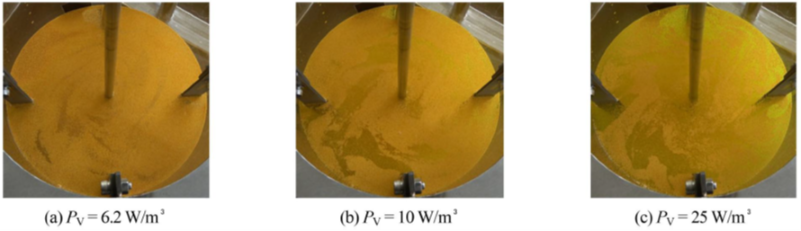
Caption: This figure visually illustrates the transition from a condition where some particles remain stationary at the liquid surface to one where the particles are in motion. It would be particularly useful for explaining the main finding to a general audience.
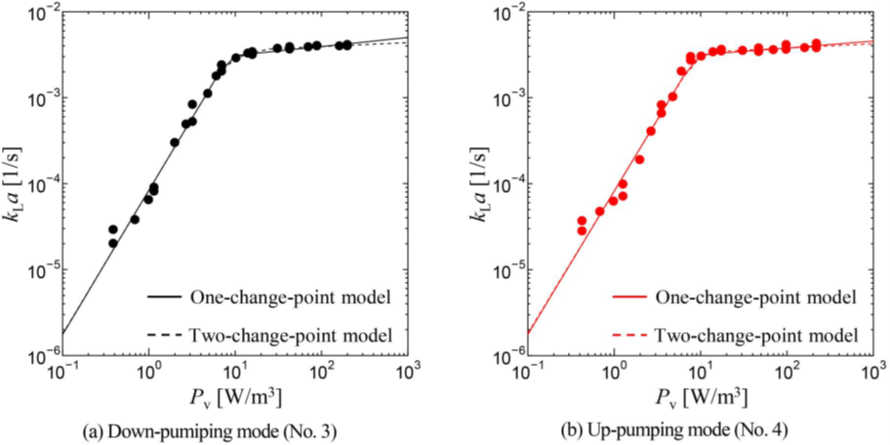
Caption: This figure demonstrates how mass transfer performance changes with increasing mixing power and highlights the change in the rate of increase.
Reference
|
Title of original paper |
Mass Transfer Characteristic for Solid-Liquid Mixing with Floating Particles |
|
Journal |
Journal of Chemical Engineering of Japan |
|
DOI |
10.1080/00219592.2026.2712141 |
|
Latest Article Publication Date |
August 17, 2026 |
About Assistant Professor FURUKAWA Haruki from Nagoya Institute of Technology, Japan
FURUKAWA Haruki is an Assistant Professor in the Department of Life Science and Applied Chemistry at the Nagoya Institute of Technology (NITech), Japan. He holds a Doctor of Engineering degree from Yokohama National University (2016) and earned his Master's (2013) and Bachelor's (2011) degrees from NITech. Over the past decade, he has published more than 80 research papers, focusing on computational fluid dynamics, fluid mixing, impeller design, and flows in viscous and viscoelastic fluids. His contributions have earned him several honors, including the 2024 "Best Reviewer Award" from The Society of Chemical Engineers, Japan.
Funding information
This research was supported by a research grant of 2025 (during 2025-2026) from Amano Institute of Technology.
Contact
Assistant Professor FURUKAWA Haruki
https://pure.nitech.ac.jp/en/persons/haruki-furukawa
E-mail : furukawa.haruki [at] nitech.ac.jp
*Please replace [at] with @ when contacting.