
 Japanese
RESEARCH NEWS Nagoya Institute of Technology Researchers Probe Dynamics of Micellar Structures under Uniaxial Extensional Stress in a New Study
Category:News|Publishing : December 24, 2025
Complex fluids, such as polymer melts and concentrated suspensions, are foundational materials for industrial products, including high-strength plastics and optical components. The final performance of these materials depends on their composition and internal microscopic structure. During manufacturing processes, however, fluids are subjected to mechanical forces that introduce internal stress, leading to microscopic structural damage, which in turn affects the material's functionality.
Despite the pressing need to observe and control this structure-stress relationship, few measurement techniques are available for fluids subjected to uniaxially extensional flow. Conventional optical techniques, owing to their low resolution and scope, fail to accurately track changes in the region of maximum stress, making it difficult to link mechanical stresses with observable optical changes.
Addressing this challenge, a research team from Nagoya Institute of Technology (NITech) in Japan, led by Assistant Professor MUTO Masakazu, recently developed a novel rheo-optical technique that can accurately characterize structural deformations in a complex fluid under extensional flow. Their work, which involved collaboration with Mr. KATO Naoki, Mr. YOSHINO Tatsuya, and Professor TAMANO Shinji, was published in Volume 37, Issue 10 of the journal Physics of Fluids on October 09, 2025.
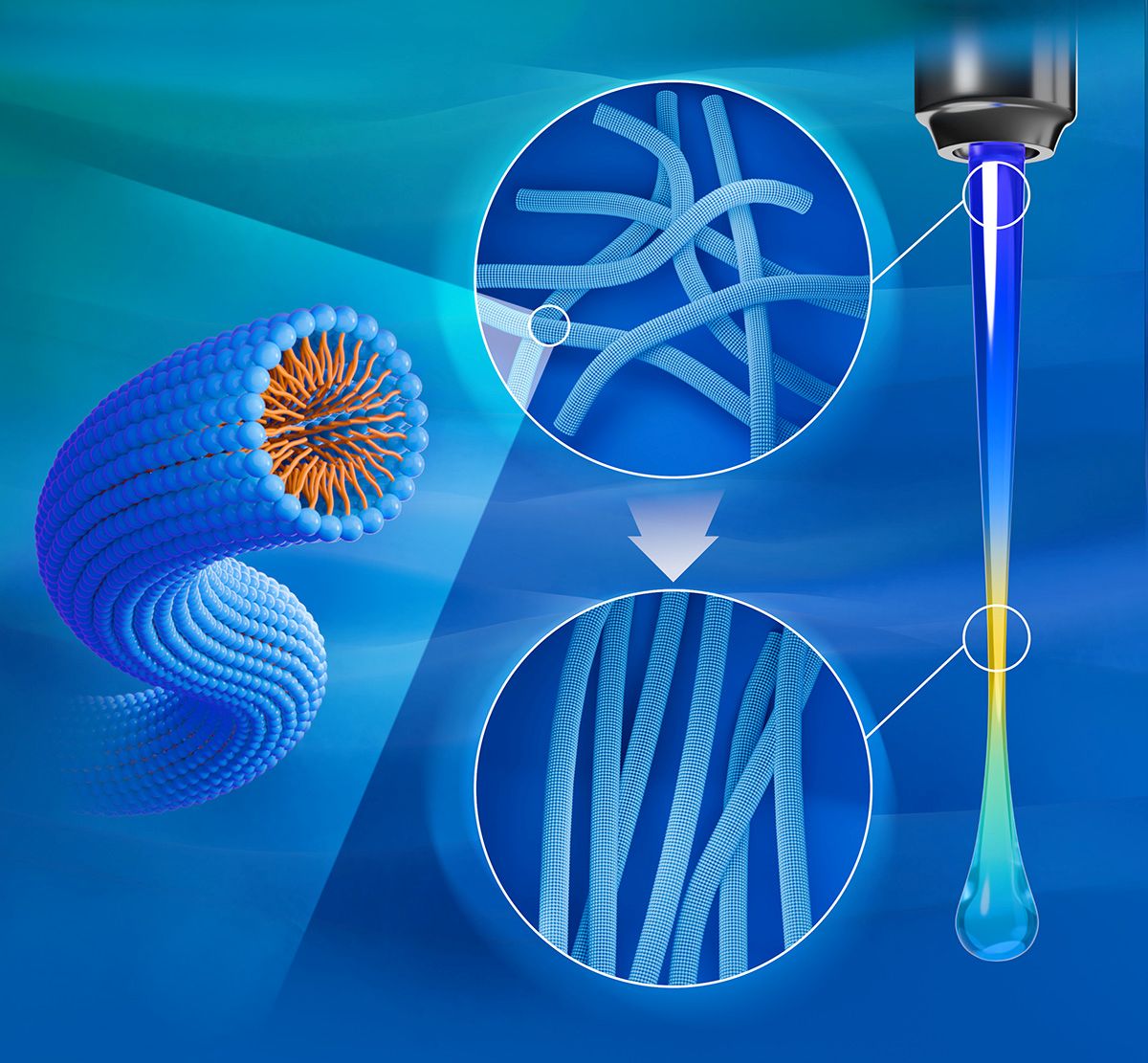
The proposed approach employs a liquid-dripping method in which a droplet of a solution is allowed to drip slowly from a nozzle. With gravity providing precise uniaxial extension, the resulting optical changes are captured using a high-speed polarization camera. The technique is non-contact and can thus accurately and simultaneously measure the macroscopic extensional stress and its associated microscopic changes to flow birefringence (optical phase retardation caused by different refractive indices for different light polarizations).
The team applied this technique to wormlike micellar solutions of cetrimonium bromide (CTAB) and sodium salicylate (NaSal) as a model of a complex viscoelastic fluid as the micelles tend to align in the direction of uniaxial stress. Following a careful analysis of the results, they found a highly accurate linear correlation between extensional stress and birefringence, confirming that the well-known "stress-optical rule" holds true under uniaxially extensional flow. Moreover, the stress-optical coefficient was found to be strongly related to the number of oriented micelles. "Our findings significantly advance our understanding of structure-property relationships in complex fluids," notes Dr. MUTO.
The ability to quantify internal stresses in complex fluids in real time opens doors to substantial innovations across many industrial fields, such as those involving polymer molding and film stretching processes. Dr. MUTO has experience in converting measured flow birefringence into stress fields, a key technique for visualizing the fluid stresses of complex fluids, such as blood in studies of subarachnoid hemorrhage. He notes that the new method will also support this line of research. "Our novel approach could contribute to the development of next-generation 'stress-aware' manufacturing technologies, where optical measurement and mechanical control are integrated in real time. This would pave the way for more reliable optical materials and medical technologies, advancing both materials science and healthcare," concludes Dr. MUTO.
Reference
|
Title of original paper |
Full-field rheo-optical analysis of wormlike and networked micellar structures under uniaxial extensional flow |
|
Journal |
Physics of Fluids |
|
DOI |
10.1063/5.0290249 |
|
Latest Article Publication Date |
October 9, 2025 |
About Assistant Professor MUTO Masakazu from Nagoya Institute of Technology, Japan
Dr. MUTO Masakazu obtained his master's and PhD degrees from Tokyo University of Science in 2015 and 2018, respectively, and joined Nagoya Institute of Technology in 2022, where he currently serves as an Assistant Professor at the Department of Mechanical Engineering. He specializes in fluidics, fluid engineering, optics, and rheology. For this study, he has received three domestic academic awards, and his work has been selected as a Featured Article in the Physics of Fluids. He has recently been honored with the Chubu Branch Lecture Award in November 2025 and Excellent Poster Presentation Award in October 2025.
Funding information
The study was supported by the Japan Society for the Promotion of Science, KAKENHI Grant No. 23K26038, and was partially based on the results obtained from project JPNP20004, subsidized by the New Energy and Industrial Technology Development Organization (NEDO).
Contact
Assistant Professor MUTO Masakazu
https://pure.nitech.ac.jp/en/persons/masakazu-muto/
E-mail : muto.masakazu [at] nitech.ac.jp
*Please replace [at] with @ when contacting.
[Initiative Introduction] - University-wide efforts to promote the use of generative AI begin~Phase 1: Generative AI Introduced to All Full-Time Faculty and Staff~ RESEARCH NEWS Nagoya Institute of Technology Researchers Model Microbubble Behavior in Viscoelastic Fluid Under Ultrasound Forcing