
 Japanese
RESEARCH NEWS Nagoya Institute of Technology Researchers Model Microbubble Behavior in Viscoelastic Fluid Under Ultrasound Forcing
Category:News|Publishing : December 24, 2025
Encapsulated microbubbles (EMBs), tiny gas-filled bubbles coated in lipid or protein shells, play a central role in biomedical ultrasound. When exposed to ultrasound waves, EMBs contract, resulting in oscillations that enhance image contrast or deliver drugs directly by creating pores in cell membranes via sonoporation. However, while promising for biomedical applications, their behavior is far more complex.
Most existing theories on EMBs assume spherically symmetrical oscillations and only study them in simple Newtonian fluids. However, most biological fluids, such as blood, are viscoelastic (non-Newtonian) fluids. When inside the body, these fluid forces, pressure from vessel walls, and changing ultrasound pulses can influence the behavior of EMBs, affecting both imaging accuracy and treatment safety.
To better understand these effects, Assistant Professor FURUKAWA Haruki and Professor IWATA Shuichi from Nagoya Institute of Technology (NITech), Japan, in collaboration with Emeritus Professor Tim N. Phillips, Dr. Michael J. Walters, and Reader Steven J. Lind from Cardiff University, Wales, developed a comprehensive computational model that simulates the behavior of EMBs under real biological conditions. Their study was made available online on November 10, 2025, and will be published in Volume 347 of the Journal of Non-Newtonian Fluid Mechanics on January 01, 2026.
"Most microbubble models assume perfect spheres and Newtonian liquids," explains Dr. FURUKAWA. "However, real biological fluids are viscoelastic, so we aimed to develop a model that simulates actual physiological conditions for a more realistic assessment of safety and efficacy."
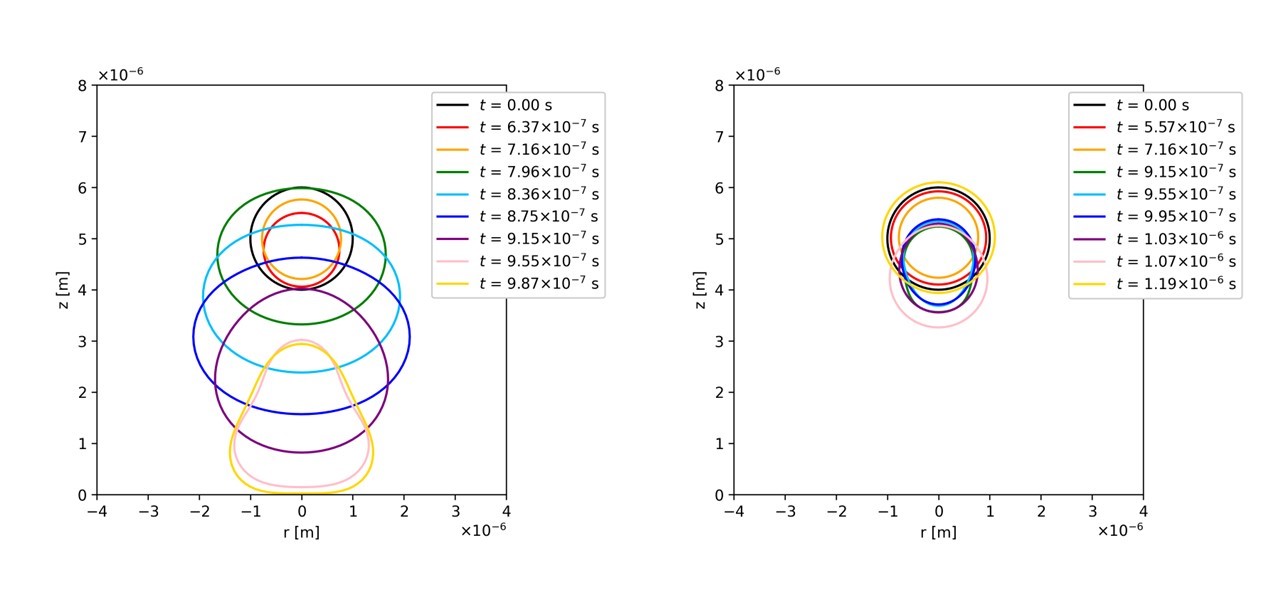
Accordingly, the researchers incorporated a non-singular boundary element method that focuses on calculations of the object's boundaries, combined with the Oldroyd B model that describes rheological behavior in viscoelastic fluids. Using this approach, they simulated a fully non-spherical, time-dependent behavior of a coated microbubble when exposed to pulsed ultrasound near a rigid wall. The coupled approach allowed them to capture key features such as asymmetric deformation, translational motion, and liquid-jet formation, which are usually missed in simple spherical models.
They found that the EMB shell thickness strongly affects bubble stability. Thick shells experienced limited deformation, lowered jet velocity, and produced smaller pressure peaks at the vessel wall. In contrast, thin shells underwent stronger motion and jetting, potentially increasing the risk of tissue damage. The results also revealed how fluid viscoelasticity competes with inertia and shell elasticity and clarified how ultrasound frequency and pressure interact with microbubble design.
"Our framework offers a cost-effective tool to assess microbubble safety," highlights Dr. FURUKAWA. "By understanding how shell properties, fluid viscoelasticity, and ultrasound settings influence EMBs, we can better guide design standards for safer diagnostics and more effective targeted treatments."
Reference
|
Title of original paper |
The influence of viscoelasticity on the dynamics of encapsulated microbubbles near a rigid surface forced by ultrasound |
|
Journal |
Journal of Non-Newtonian Fluid Mechanics |
|
DOI |
10.1016/j.jnnfm.2025.105518 |
|
Latest Article Publication Date |
November 10, 2025 |
About Assistant Professor FURUKAWA Haruki from Nagoya Institute of Technology, Japan
Dr. FURUKAWA Haruki is an Assistant Professor in the Department of Life Science and Applied Chemistry at the Nagoya Institute of Technology (NITech), Japan. He holds a Doctor of Engineering degree from Yokohama National University (2016) and earned his Master's (2013) and Bachelor's (2011) degrees from NITech. Over the past decade, he has published more than 78 research papers, focusing on computational fluid dynamics, fluid mixing, impeller design, and flows in viscous and viscoelastic fluids. His contributions have earned him several honors, including the 2024 "Best Reviewer Award" from The Society of Chemical Engineers, Japan.
Funding information
This research was partly supported through a Ph.D. studentship for MJW funded by the Cardiff School of Mathematics. This work was also supported by JSPS KAKENHI (Grant Numbers JP23K03673 and JP20K04285). Dr. FURUKAWA Haruki would like to acknowledge funding from the NITech Funding Program for Researcher Overseas Visits.
Contact
Assistant Professor FURUKAWA Haruki
http://www.ach.nitech.ac.jp/~chemeng/ekakoken.html
E-mail : furukawa.haruki [at] nitech.ac.jp
*Please replace [at] with @ when contacting.
RESEARCH NEWS Nagoya Institute of Technology Researchers Probe Dynamics of Micellar Structures under Uniaxial Extensional Stress in a New Study RESEARCH NEWS Nagoya Institute of Technology Researchers Develop a Non-Invasive Platform to Visualize Dynamic Stress Fields in Blood Analogues and Artificial Vessel Walls