
 Japanese
RESEARCH NEWS Nagoya Institute of Technology Researchers Develop a Non-Invasive Platform to Visualize Dynamic Stress Fields in Blood Analogues and Artificial Vessel Walls
Category:News|Publishing : December 24, 2025
Hemodynamics, the field of study concerned with blood flow and its interaction with the vascular walls, often relies on simplified assumptions to enable understanding of the circulatory system. This is because blood, which is a non-Newtonian fluid (a fluid whose viscosity changes with the application of shear stress), makes for a complex interaction with the blood vessel walls during its flow owing to the wall shear stress exerted by the flow. In addition, the blood vessel itself behaves as an elastic body, undergoing deformation in response to these stresses, which further complicates the overall flow dynamics and stress interactions.
So far, it has proved to be challenging to analyze this blood-vessel interaction using traditional experimental and numerical methods. Such an analysis, however, is crucial for understanding the mechanics of cardiovascular diseases as well as for designing safer and more reliable medical devices.
Against this backdrop, Assistant Professor MUTO Masakazu, along with Mr. SAWAI Akihito, Mr. UMEZAWA Ryo, and Professor TAMANO Shinji from Nagoya Institute of Technology (NITech) and Assistant Professor KOBAYASHI Kazuya U. from Nippon Institute of Technology in Japan, recently developed a new experimental platform that allowed them to visualize how blood flow mechanically interacts with the vascular walls via dynamic stress fields. The platform utilizes a technique called photoelasticity that enables real-time observation of both fluid and solid stresses, and has traditionally found use in solid mechanics. Their work was published in the journal Physics of Fluids on August 07, 2025.
"We have developed the world's first experimental platform that directly visualizes hydrodynamic stress fields using photoelasticity. This technique offers a new way to predict rupture risks in diseases such as brain aneurysms by directly visualizing the stress interactions between fluids and elastic solids," highlights Dr. MUTO.
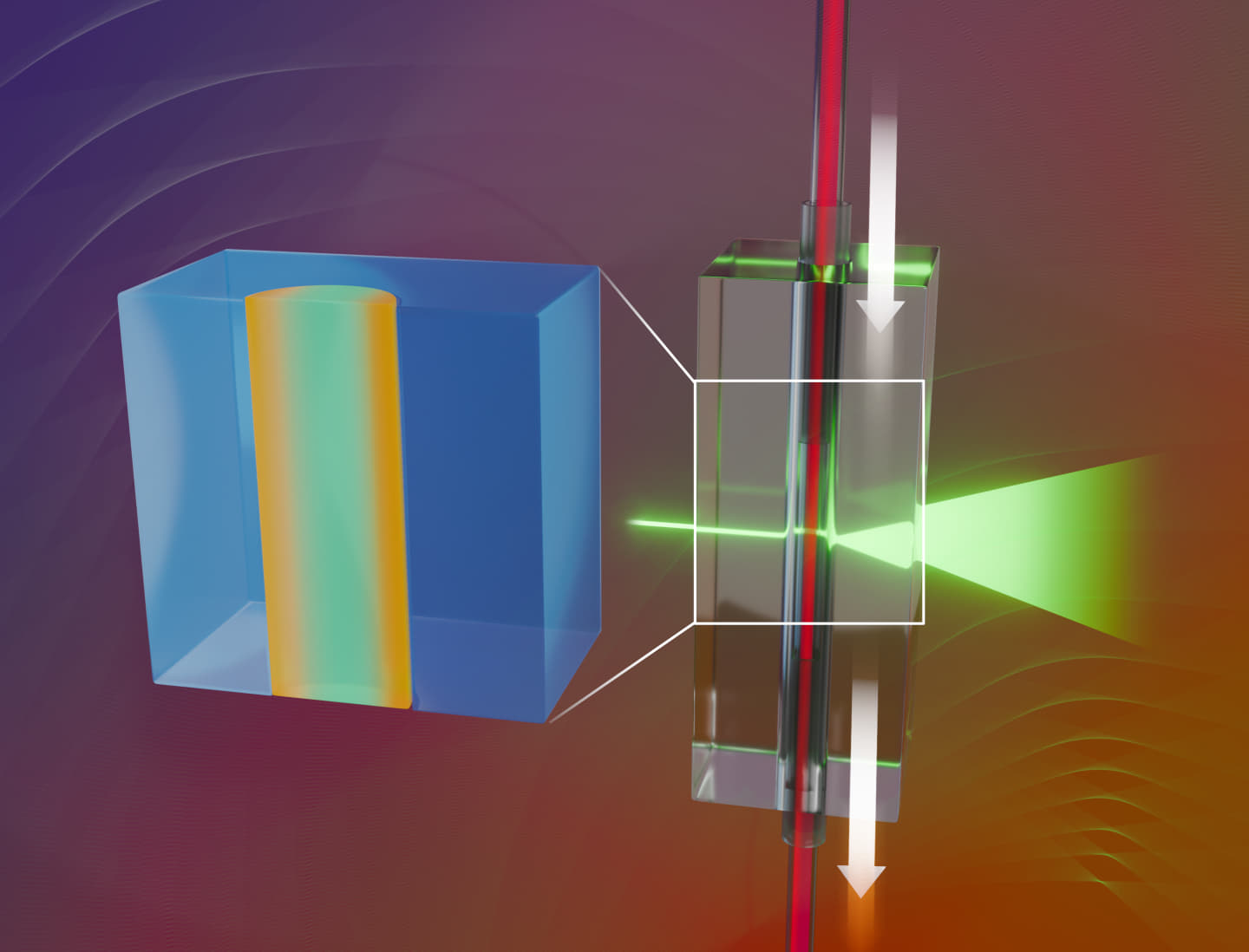
Photoelasticity is an optical phenomenon in which materials change how they transmit polarized light when exposed to mechanical stress. When polarized light passes through the material, which is squeezed, stretched, or sheared, the light splits into slightly different paths, a phenomenon called birefringence. This in turn creates visible patterns in the light that directly correspond to the amount and direction of stress within the material.
In their study, the researchers placed flexible artificial channels that mimic real blood vessels between a polarized light source and a high-speed camera, then pumped a blood analogue fluid through them. As the fluid flowed, it pushed and pulled onto the channel walls, altering how the material interacted with light. The camera captured these changes in real time, enabling the team to map not only the stresses within the elastic vessel walls but also the hydrodynamic stress fields inside the flowing fluid. Importantly, the novelty of the method lies in its ability to visualize both stress fields and their dynamic interactions as they evolve in real time.
Using this setup with pulsating flows that mimic a heartbeat, the team observed that the wall shear stress increased with the flow rate. The highest stresses were concentrated near the channel's inner wall and gradually decreased outward, a pattern that closely matches the force distribution in the human body.
This setup offers a powerful experimental tool for understanding the mechanical processes behind cardiovascular diseases such as cerebral aneurysms.
"In the future, this approach will enable realistic analysis of cardiovascular mechanics under pulsatile flow and could pave the way for the development of safer and more reliable medical devices, such as artificial hearts and catheters, by allowing engineers to evaluate medical devices under body-like conditions," concludes Dr. MUTO.
Reference
|
Title of original paper |
Development of solid-liquid birefringence method targeting |
|
Journal |
Physics of Fluids |
|
DOI |
10.1063/5.0276256 |
|
Latest Article Publication Date |
August 07, 2025 |
About Assistant Professor MUTO Masakazu from Nagoya Institute of Technology, Japan
Dr. MUTO Masakazu obtained his master's and PhD degrees from Tokyo University of Science in 2015 and 2018, respectively, and joined Nagoya Institute of Technology in 2022, where he currently serves as an Assistant Professor at the Department of Mechanical Engineering. He specializes in fluidics, fluid engineering, rheology, and manufacturing technologies. For this study, he has received four domestic academic awards, and his work has been selected for the AIP Publishing Showcase. He has recently been honored with the Chubu Branch Lecture Award in November 2025 and Excellent Poster Presentation Award in October 2025.
Funding information
This work was supported by JSPS KAKENHI, Grant Number JP23H01343; the Nakatani Foundation for Advancement of Measuring Technologies in Biomedical Engineering; and a project (JPNP20004) subsidized by the New Energy and Industrial Technology Development Organization (NEDO).
Contact
Assistant Professor MUTO Masakazu
https://pure.nitech.ac.jp/en/persons/masakazu-muto/
E-mail : muto.masakazu [at] nitech.ac.jp
*Please replace [at] with @ when contacting.
RESEARCH NEWS Nagoya Institute of Technology Researchers Model Microbubble Behavior in Viscoelastic Fluid Under Ultrasound Forcing An International Collaborative Study by KATAYAMA and FURUTANI Lab with the Paul Scherrer Institute (Switzerland) Has Been Published in the Journal of Molecular Biology