
 Japanese
Assistant Professor KOIZUMI Toru, Professor TSUMURA Tomoaki group wins 1st Place at the Next-Generation Championship in Branch Prediction (CBP-NG)
Category:Award|Publishing : November 13, 2026
The Next-Generation Championship in Branch Prediction (CBP-NG) 1st Place
Award Winner
KOIZUMI Toru, Assistant Professor, Computer Science Group
TSUMURA Tomoaki, Professor, Computer Science Group
MIZUNO Masanari, Department of Engineering, Program of Networks
NISHIDA Soma, Department of Engineering, Program of Networks
others
Award-Winning Research
MORSL: Minimal-Overhead Rank-Based Predictor with Summation-Free Correction and Lazy Access
Related Website of The Winner
Research/Faculty Navi (KOIZUMI Toru)
Research/Faculty Navi (TSUMURA Tomoaki)
Related Website
The Next-Generation Championship in Branch Prediction (CBP-NG)
Outline
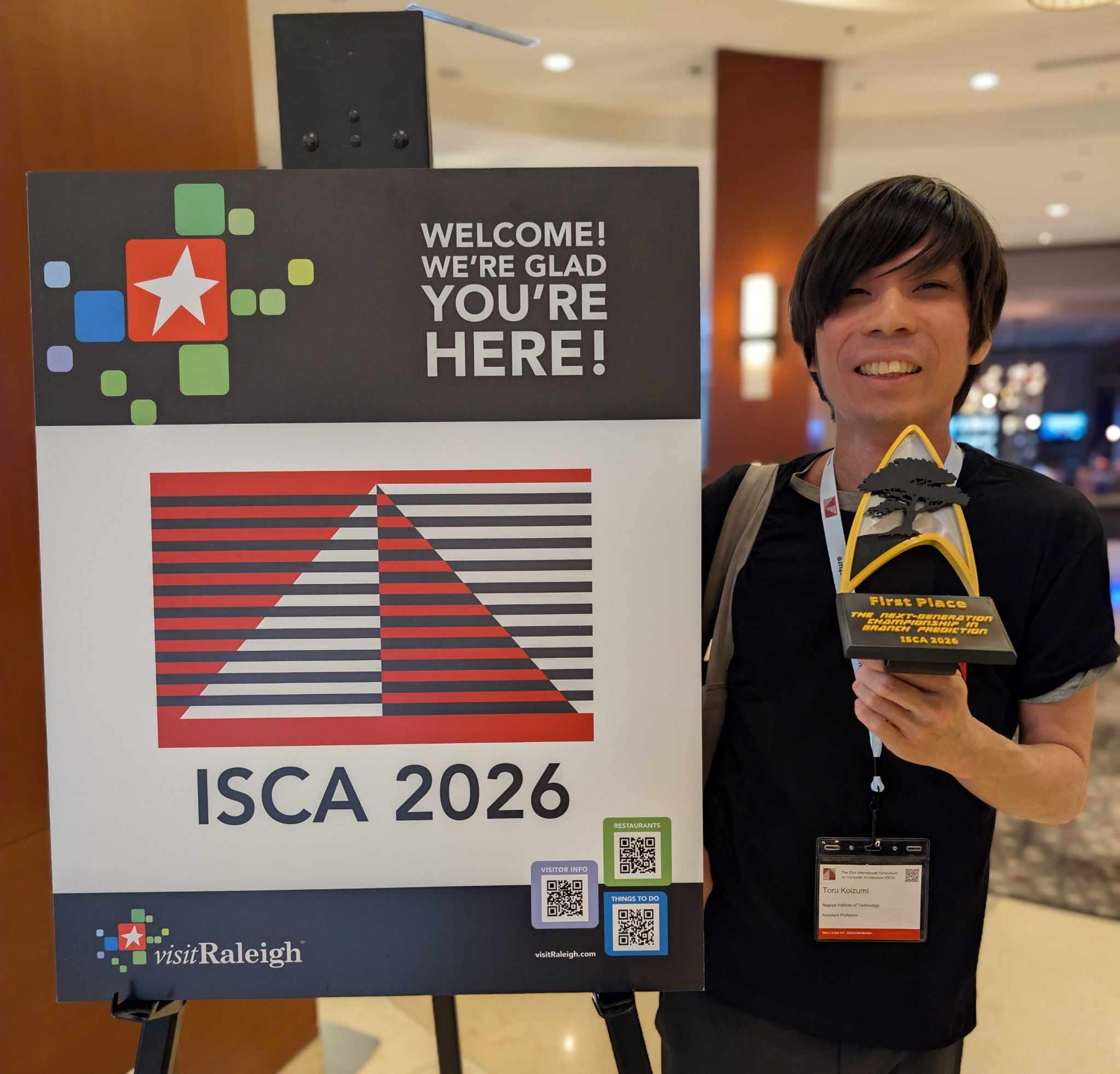
At CBP-NG, held in conjunction with ISCA 2026, a leading conference in computer architecture, a team led by Assistant Professor KOIZUMI Toru of Nagoya Institute of Technology won first place. The team also won CBP2025 last year, achieving its second consecutive victory.
CBP (Championship Branch Prediction) is an academic competition that evaluates algorithms for branch prediction, a technique that has become increasingly important in modern high-performance CPUs. The TAGE branch predictor, which has won past CBP competitions, and its derivatives have had a significant impact on industry, including their adoption in commercial processors. CBP is an important competition that will help shape the future of branch predictors.
This year's CBP-NG was conducted as a next-generation version of the previous CBP, with revised evaluation criteria. Traditionally, prediction accuracy--the ability to accurately predict branch outcomes within limited memory capacity--was almost the sole evaluation criterion. In CBP-NG, however, even the most accurate predictor cannot be implemented in an actual processor if its power consumption or latency is too high. Therefore, in addition to prediction accuracy, the power consumed during prediction and the time required to produce a prediction (latency) are also evaluated.
The group led by Assistant Professor KOIZUMI Toru and Professor TSUMURA Tomoaki proposed MORSL, a branch predictor designed to reduce the number of circuits activated for each prediction while maintaining prediction accuracy. By combining multiple innovations, including a mechanism that accesses tables only when necessary, the group significantly reduced unnecessary power consumption and latency, achieving the highest score among teams worldwide. Under the revised evaluation criteria, the team retained its top position and secured its second consecutive victory, following last year's win.
List of Award Winners (Posted on the Japanese Website July 1 - September 30, 2026)