
 Japanese
RESEARCH NEWS New Study from NITech Researchers Reports Ionic Liquid Membrane-Based Recovery of Nitrogen Compounds from Liquid Fuels
Category:News|Publishing : September 14, 2026
Caption: A research team from NITech applies a silsesquioxane framework-based ionic liquid (SQIL) membrane to pervaporation separation system to selectively separate and recover pyridine from binary and multicomponent hydrocarbon mixtures.
Biomass-derived oils are important sustainable alternatives to petroleum-based liquid fuels. However, biomass oil mixtures contain much higher concentrations of cyclic nitrogen compounds that contribute to NOx emissions and deactivate refining catalysts. This necessitates their removal by a hydrogen-intensive hydrodenitrogenation (HDN) process that consumes high energy. Therefore, efficient pre-HDN removal of nitrogen compounds is required to lower hydrogen and energy consumption when upgrading nitrogen-rich liquid fuels.
In a recent breakthrough, Dr. HIROTA Yuichiro, an Associate Professor at Nagoya Institute of Technology in Japan, collaborated with Dr. IKEDA Ayumi at the National Institute of Advanced Industrial Science and Technology (AIST) and Professor ARAKI Sadao at Kansai University in Japan to demonstrate the feasibility of membrane-based pre-denitrogenation, which separates nitrogen compounds from hydrocarbons in liquid fuels. Their study was made available online on July 15, 2026, and was published in Volume 410 of the journal Separation and Purification Technology on October 22, 2026.
Dr. HIROTA's group has been developing what are called silsesquioxane framework-containing ionic liquid (SQIL) membranes for the selective separation of gases and organic liquid mixtures based on molecular affinity between the immobilized ionic liquid and permeating molecules. "Our previous observation that SQIL membranes can selectively separate polar and nonpolar organic liquids led us to apply this membrane technology for separating nitrogen compounds from hydrocarbons," explains Dr. HIROTA.
The research team employed SQIL membranes, polySipmimTf2N, and applied them to a pervaporation (PV) separation system. The compounds pyridine, toluene, and n-heptane were used to model nitrogen compounds, aromatic hydrocarbons, and alkanes, respectively. Using single, binary, or ternary mixtures of these compounds, they demonstrated that the SQIL membranes selectively permeated pyridine based on affinity rather than size. The pyridine enrichment exceeded vapor-liquid equilibrium limitations, indicating preferential binding to the membrane. In binary mixtures, pyridine permeation was also noted to be concentration dependent.
This study demonstrated for the first time that the SQIL membrane can selectively enrich pyridine not only from a binary mixture but also from a more realistic multicomponent hydrocarbon mixture containing both aromatic and aliphatic hydrocarbons. Speculating on the real-world implications of their findings, Dr. HIROTA concludes, "Our study findings present an alternative approach that could help reduce hydrogen consumption and enable milder upgrading conditions for nitrogen-rich biomass-derived oils. Ultimately, this technology may contribute to more energy-efficient production of next-generation liquid fuels."
Indeed, this technological advancement raises hopes of energy-efficient biomass-liquid fuel production, which could achieve wider use of this sustainable energy source.
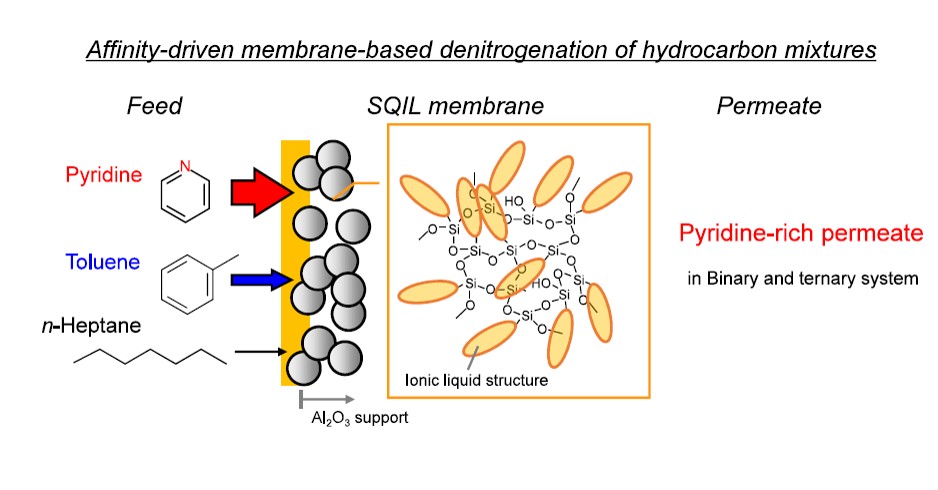
Caption: A silsesquioxane framework-containing ionic liquid (SQIL) membrane applied to pervaporation separation system achieved selective affinity-driven denitrogenation of binary and multicomponent hydrocarbon mixtures, underscoring its potential as a pre-treatment technology in processing nitrogen-rich liquid fuels.
Reference
|
Title of original paper |
Separation of pyridine from aromatic and aliphatic hydrocarbons using a silsesquioxane framework-containing ionic liquid membrane |
|
Journal |
Separation and Purification Technology |
|
DOI |
10.1016/j.seppur.2026.139353 |
|
Latest Article Publication Date |
October 22, 2026 |
About Assistant Professor HIROTA Yuichiro from Nagoya Institute of Technology, Japan
Dr. HIROTA Yuichiro is an Associate Professor at the Department of Life Science and Applied Chemistry at Nagoya Institute of Technology (NITech). Prior to joining NITech, Dr. HIROTA served as an Assistant Professor at Osaka University (2015-2020) and the Tokyo Institute of Technology (2012-2015). His research expertise lies in the field of chemical engineering, specifically ionic liquid membrane separation, zeolites, transport phenomena, and process system engineering. His illustrious career is underscored by 79 high-impact publications in top scientific journals and Research Encouragement awards.
Funding information
This study was partially supported by JSPS KAKENHI (Grant Number JP24K08144). The 1H NMR measurement, FE-SEM observation, and EDS analysis were supported by the Equipment Sharing Division, Organization for Co-Creation Research and Social Contributions, Nagoya Institute of Technology.
Contact
Associate Professor HIROTA Yuichiro
https://www.nitech.ac.jp/faculty/hirota-yuichiro.html
https://www.ach.nitech.ac.jp/chemeng/
E-mail : hirota.yuichiro [at] nitech.ac.jp
TEL : +81-52-735-5357
*Please replace [at] with @ when contacting.